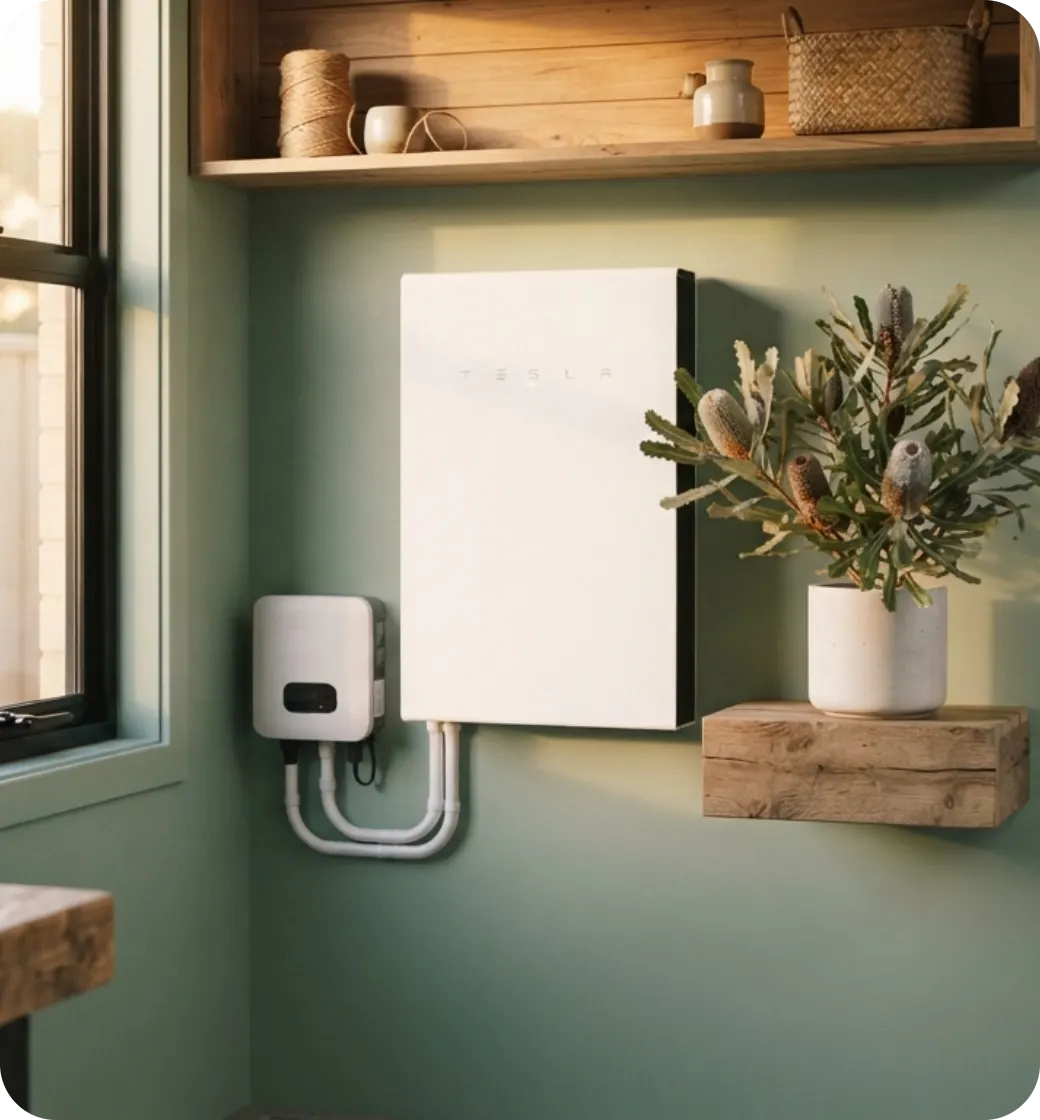
Choosing a solar battery in Australia in 2026 is very different from two years ago. First, virtually every major brand on the Clean Energy Council (CEC) approved list now uses safe, long-life LiFePO4 (LFP) chemistry. Second, since 1 May 2026, the federal Cheaper Home Batteries Program pays 100% of the STC subsidy up to 14 kWh of usable capacity (worth up to $3,767 at $39.65/STC in May–Dec 2026) and tapers to 60% between 14 and 28 kWh.
That 14 kWh full-rate ceiling makes single-stack batteries in the 10 to 14 kWh usable band the sweet spot for most Australian homes. Below, we compare the eight leading battery systems in Australia on the specs that actually matter: usable kWh, continuous backup power (kW), inverter coupling, warranty throughput conditions, and net installed cost after the 2026 federal discount.
Check the exact 2026 federal and state rebate for any usable kWh size, then test its payback on your bill.
Quick verdict: best home battery in Australia by use case (Oct 2026)
- Best all-in-one & retrofit (whole-home backup): Tesla Powerwall 3 (13.5 kWh). Massive 11.04 kW continuous single-phase output, built-in 6-MPPT solar/battery inverter, IP67 flood resistance, and unlimited-cycle warranty for solar self-consumption and VPPs.
- Best value per kWh (with matching hybrid inverter): Sungrow SBR 12.8 HV or FoxESS ECS/EQ. Lowest net installed cost per kWh ($5,200–$11,370 net for Sungrow 9.6–12.8 kWh; $6,800–$8,300 net for FoxESS 10–14 kWh) when paired with a Sungrow or FoxESS hybrid inverter.
- Best modular & three-phase / EV-ready system: Sigenergy SigenStor (5.2 to 48+ kWh). Stackable 5-in-1 tower with 0 ms UPS switchover, IP66 rating, and an optional plug-in 12.5 kW or 25 kW bidirectional DC EV fast-charger module.
- Best inverter flexibility (Fronius / SMA / GoodWe): BYD Battery-Box Premium HVS / HVM. Proven modular cobalt-free LFP towers (5.1 to 22.1 kWh per stack) with ≥96% round-trip efficiency that pair with Australia's favourite European and Asian hybrid inverters.
- Best warranty & microinverter redundancy: Enphase IQ Battery 5P (5.0 / 10.0 kWh). Industry-leading 15-year / 6,000-cycle warranty, four embedded IQ8D-BAT microinverters per 5 kWh block (no single point of failure), and 3.84 kW continuous output per 5 kWh module.
2026 Australian home battery comparison table (specs, warranty & net price)
All prices below are indicative Australian installed ranges (including GST) compiled from the Solar Choice Battery Price Index (Aug/Sept 2026) and September–October 2026 installer quote surveys, shown alongside the exact May–December 2026 federal STC discount (`6.8` factor, `$39.65/STC`):
| Battery model | Usable kWh | Continuous power | Coupling / Inverter | Warranty (SOH%) | 2026 federal discount | Net installed price (AU) |
|---|---|---|---|---|---|---|
| Tesla Powerwall 3All-in-One | 13.5 kWh | 11.04 kW | Built-in hybrid / AC inverter + Gateway | 10 yrs (70% · unlimited solar/VPP cycles) | −$3,608 (91 STCs) | $11,400–$13,640 |
| Sungrow SBR 12.8 HV | 12.8 kWh | 7.68–9.6 kW | DC (requires Sungrow SH hybrid inverter) | 10 yrs (throughput cap applies) | −$3,450 (87 STCs) | $5,200–$11,370* |
| BYD Battery-Box HVM 13.8 | 13.8 kWh | ~10.2 kW | DC (Fronius Gen24, SMA, GoodWe, Sungrow) | 10 yrs (70% · throughput cap) | −$3,687 (93 STCs) | $7,460–$12,320* |
| Sigenergy SigenStor (15.6 / 16 kWh) | 15.6 kWh | 7.5–8.0 kW | All-in-one hybrid tower (1P or 3P) | 10 yrs (70% · opt. 15-yr extension) | −$4,005 (101 STCs) | $11,960–$13,960 |
| Enphase IQ Battery 5P (2× = 10 kWh) | 10.0 kWh | 7.68 kW | AC-coupled (built-in IQ8D microinverters) | 15 yrs or 6,000 cycles (>60%) | −$2,696 (68 STCs) | $11,300–$12,300 |
| AlphaESS SMILE-G3 / SMILE5 | 10.1–13.3 kWh | 5.0 kW | All-in-one hybrid or AC-coupled | 10 yrs battery (5 yrs inverter) | −$2,736 to −$3,569 | $7,660–$11,250 |
| GoodWe Lynx Home F G2 (12.8 kWh) | 12.8 kWh | ~8.96 kW | DC (requires GoodWe EH/ET hybrid inverter) | 10 yrs (70% · throughput cap) | −$3,450 (87 STCs) | $8,570–$10,570* |
| FoxESS EQ4800 / ECS (10–14 kWh) | 10.0–14.0 kWh | 5.0–10.0 kW | DC (requires FoxESS H1/H3 hybrid inverter) | 10 yrs (70% · up to 12 yrs on CQ6) | −$2,696 to −$3,767 | $6,800–$8,300* |
*Note on DC-coupled battery prices: Lower end of the range is for adding battery modules to an existing compatible hybrid inverter. If your quote includes supplying and fitting a new hybrid inverter (+$2,000–$3,000), expect prices toward the upper end of the range.
Head-to-head: how the top 5 brands actually differ
1. Tesla Powerwall 3 (13.5 kWh usable) — Best all-in-one & high-power backup
The Powerwall 3 remains the benchmark for single-phase Australian homes because it integrates a 13.5 kWh LFP battery and an 11.04 kW continuous inverter with 6 solar MPPTs inside one IP67-rated enclosure. While many 10–13 kWh batteries cap continuous discharge at 5 kW (meaning turning on the ducted air conditioner and oven together pulls power from the grid), the Powerwall 3 can deliver up to 11.04 kW continuously (48A) and start heavy air-conditioning compressors during a blackout.
Downsides: It is heavy (130 kg), not modular in small 3 kWh steps (you expand in 13.5 kWh increments), and on three-phase homes a single Powerwall 3 backs up only one phase unless configured carefully by your electrician.
2. Sungrow SBR (9.6–25.6 kWh) & SBH Series — Best value solar + battery ecosystem
Sungrow is Australia's highest-volume solar + battery manufacturer. Its modular SBR high-voltage LFP stack (in 3.2 kWh bricks from 9.6 kWh up to 25.6 kWh, plus the newer 5 kWh-per-module SBH series for larger homes) pairs seamlessly with Sungrow's SH-RS (single-phase) and SH-T (three-phase) hybrid inverters.
Why Australians buy it: If you are installing new solar panels and a battery at the same time (or already have a Sungrow SH hybrid inverter on the wall), a Sungrow SBR 12.8 kWh system typically lands $2,500 to $4,500 cheaper than a Powerwall 3 while delivering fast 20ms blackout switchover and 96% DC round-trip efficiency.
3. BYD Battery-Box Premium HVS / HVM — Best inverter freedom
Unlike Tesla or Sungrow (which lock you into their own inverters), BYD builds modular, cobalt-free LFP battery towers that are officially certified with Australia's top hybrid inverters, including Fronius Primo/Symo GEN24 Plus, SMA, GoodWe and Sungrow. The HVS series (2.56 kWh modules, 5.1 to 12.8 kWh) runs at higher voltage for maximum efficiency, while the HVM series (2.76 kWh modules, 8.3 to 22.1 kWh) scales higher per tower.
4. Sigenergy SigenStor (5.2 to 48+ kWh) — Best for three-phase & EV owners
Sigenergy has rapidly captured Australian market share with its modular 5-in-1 tower (`SigenStor`), which stacks a hybrid inverter (`Energy Controller`), LFP battery packs (5.2 kWh or 7.8/8.0 kWh usable modules), and an optional 12.5 kW or 25 kW bidirectional DC EV charger into one sleek IP66 column. It offers true 0 ms UPS switchover during blackouts and native three-phase balancing.
5. Enphase IQ Battery 5P (5.0 kWh modular) — Best warranty (15 years) & shade/microinverter fit
If your roof already uses Enphase microinverters (or has heavy tree/chimney shading), the AC-coupled Enphase IQ Battery 5P is the standout premium option. Each 5.0 kWh unit contains four independent IQ8D-BAT microinverters delivering 3.84 kW continuous power (7.68 kVA peak for 3 seconds) — meaning a 10 kWh pair (2× 5P) delivers 7.68 kW continuously, and if one microinverter ever faults, the other three keep running. It is also the only major battery in Australia backed by a standard 15-year / 6,000-cycle warranty.
3 warranty traps to check before you sign any battery quote
Almost every brochure says "10-year warranty", but Australian battery warranty documents contain three critical catches:
- Throughput caps vs unlimited cycles: Most 10-year warranties end at 10 years OR a set megawatt-hour (MWh) energy throughput limit, whichever comes first. If you cycle your battery twice a day (once on daytime solar, once on a cheap night/midday grid plan or VPP), you can hit a low throughput cap in year 7 or 8. Tesla Powerwall 3 explicitly allows unlimited cycles for solar self-consumption, time-of-use control and VPP/backup events.
- Mandatory internet connection requirement: Tesla, Sigenergy, GoodWe and FoxESS all reduce your warranty (sometimes down to 4 or 5 years!) if the battery is left disconnected from the internet for an extended period and cannot receive firmware updates. Make sure your Wi-Fi reaches your garage or side wall.
- Ambient temperature & direct sun (AS/NZS 5139): While LFP batteries operate up to 50°C, Australian warranties void or derate batteries mounted in direct western afternoon sunlight. Always install under eaves, in a shaded side passage, in a garage, or under a compliant weather hood.
How to choose the right size and brand for your home
Follow this three-step sequence so you don't overpay:
- Size to your evening load first: Check your smart meter data from sunset to sunrise and run it through our home battery sizing tool. Over 90% of Australian homes need 7 to 14 kWh of usable capacity — right inside the 100% federal rebate tier.
- Match your inverter power (kW) to your peak load: A 13 kWh battery behind a 5 kW inverter can only supply 5 kW at once. If you want to run ducted air conditioning and induction cooking off the battery without drawing from the grid, look at high-output models like Powerwall 3 (11.04 kW), Sigenergy, Enphase 2×5P (7.68 kW) or Sungrow/BYD paired with an 8–10 kW hybrid inverter.
- Check your exact rebate and payback: Run your shortlisted model's usable kWh and quote price through our 2026 battery rebate calculator and payback calculator.
Sources
CHECKED 24 OCT 2026- Clean Energy Council (CEC): Approved solar batteries list
- Solar Choice: 2026 Australian battery brand prices & Solar Battery Price Index (updated Sept 2026)
- Why Solar: Compare Solar Batteries 2026 — Tesla vs Sungrow vs BYD vs FoxESS vs Enphase (checked 30 Sept 2026)
- Solar Power Savings: 2026 installed solar battery prices by brand (checked 10 Oct 2026)
- Melbourne Solar Guide: Australian battery warranty comparison (throughput limits, SOH% & connectivity clauses)
- Enphase Energy ANZ: IQ Battery 5P datasheet & 15-year / 6,000-cycle warranty
- Clean Energy Regulator: Cheaper Home Batteries Program STC factors and 14/28/50 kWh taper
StoredWatts is independent. Partner commissions never change our calculators or what we write. General information only, not financial advice.